A running coach for people who'd rather not get hurt
Most running apps
push you to do more.This one tells
you to stop.
Furlong reads your running history from Apple Health, models the load you're carrying, and each morning tells you one thing: run this, or don't, and why.
iPhone. Free. No account, no ads, nothing sent anywhere.
Counting is not
the same as coaching.
Tracking apps record what you did. Social apps show you what everyone else did. Neither one knows the difference between a week you can absorb and a week that sets you back.
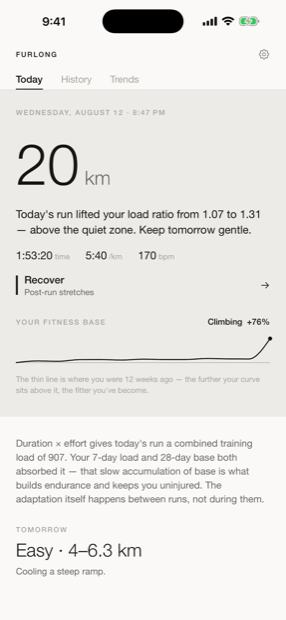
Most running injuries are not caused by a single bad session. They build up over a good block of training laid on top of another one, before the tissue has adapted. Furlong watches how quickly your load is changing, not only the weekly total, so it can ease off before you feel it.
What it does
One thing each morning
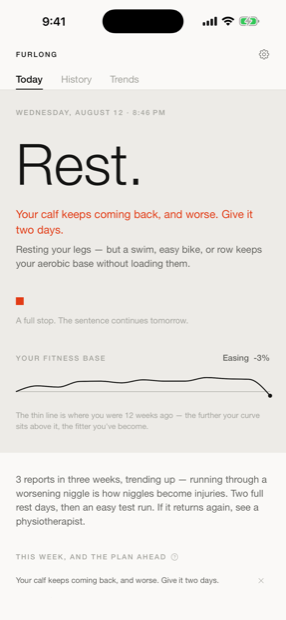
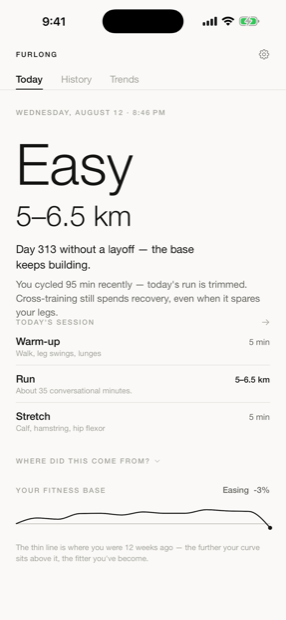
A distance and an effort, or a rest day. There is no dashboard to interpret.
The reason, always
Every recommendation shows the cause behind it. You can always ask where it came from.
Sees it coming
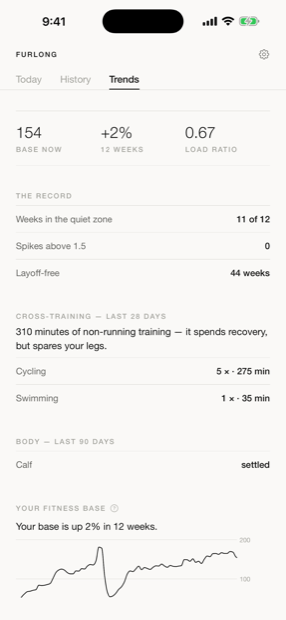
Compares your recent work against the base you have built, and eases off before a week gets away from you.
Listens to niggles
Report one and the plan holds until it settles. It will say plainly when something is beyond what an app should advise on.
Builds the long run
Deliberately, week by week, instead of letting it drift.
Works around your life
Pick your long-run day, add a race, and the plan rebuilds around it.
The thinking
Fitness improves faster
than tissue.
Your cardiovascular system responds to training within a few weeks. Tendon, bone and other connective tissue take considerably longer; bone remodelling is a matter of months. That mismatch is the practical problem in distance running. You feel capable of more before your structures can tolerate it, and the session that hurts is seldom the session that caused the damage.
Most running injuries are load errors rather than accidents. They come from a solid block of training laid on top of another one, at a point where the tissue has not caught up. The useful question is therefore not how far you ran this week. It is how far you ran compared with what you have been doing for the past month or two.
Furlong keeps track of both, and reasons about the distance between them.
The baseline is yours
Tolerance is individual, and it is set by history. Forty kilometres is an ordinary week for one runner and a marked increase for another. Furlong measures you against your own recent months, not against a schedule written for somebody else.
Rate of progression is the risk
Absolute volume matters less than how quickly you arrived at it. Gradual progression is what tissue adapts to. Abrupt progression is what it fails under.
Load is not only running
Time on your feet, cross-training and poor sleep all contribute. Tissue does not distinguish between a deliberate training stimulus and a long day at work.
What it won't tell you
Whether you are going to get injured
No model does this reliably for an individual. Training load is one contributor among many, alongside sleep, stress, biomechanics, footwear, running surface, previous injury and chance. Furlong flags a week that looks disproportionate for you. It does not forecast an outcome.
A single readiness number
Composite scores hide the reasoning that produced them, and they encourage people to train the number instead of the training. Every recommendation here shows what drove it, so you can judge whether it applies to you today.
Anything it cannot yet support
In the first few weeks there is not enough history to say much. Furlong says so and stays conservative, rather than producing a confident-looking figure from thin data.
What to do about pain
Pain that recurs, worsens, or alters how you move needs assessment by a clinician, not a shorter route. The app says this plainly and stops issuing suggestions until it is resolved.
Worth stating plainly: the acute-to-chronic workload ratio emerged from team-sport research, was widely adopted, and has since been criticised on methodological grounds. The association is weaker and less specific than the early papers implied, and it was never established as an individual predictor. What survives that critique is the underlying principle, which is not controversial: increase gradually, in proportion to what you have actually been doing. Furlong applies that principle and declines to dress it up as a risk score. Every recommendation shows its reasoning, so you are able to disagree with it.
Privacy
Nothing leaves your phone.
This is not a promise about how we behave. Furlong contains no networking code at all, so there is no mechanism by which your data could be sent anywhere. None was built.
- No account, no sign-up, no server
- No analytics, no crash reporting, no third-party SDKs
- No ads, ever. Your health data is nobody's business, including ours
- Reads Apple Health; never writes to it
- Everything stored on your device, and erasable in one tap
Who it's not for
If you want kudos, leaderboards, segments or a feed, this is the wrong app and you'll dislike it. If you want to be told to push harder every day, you'll dislike it more.
The fastest runner is the one who isn't injured.
Furlong offers training guidance, not medical advice. It does not diagnose, treat or prevent injury or any medical condition, and it cannot know what's happening in your body. Pain that persists, worsens, or changes how you move should be assessed by a doctor or physiotherapist rather than an app. Seek professional advice before starting or changing an exercise programme.